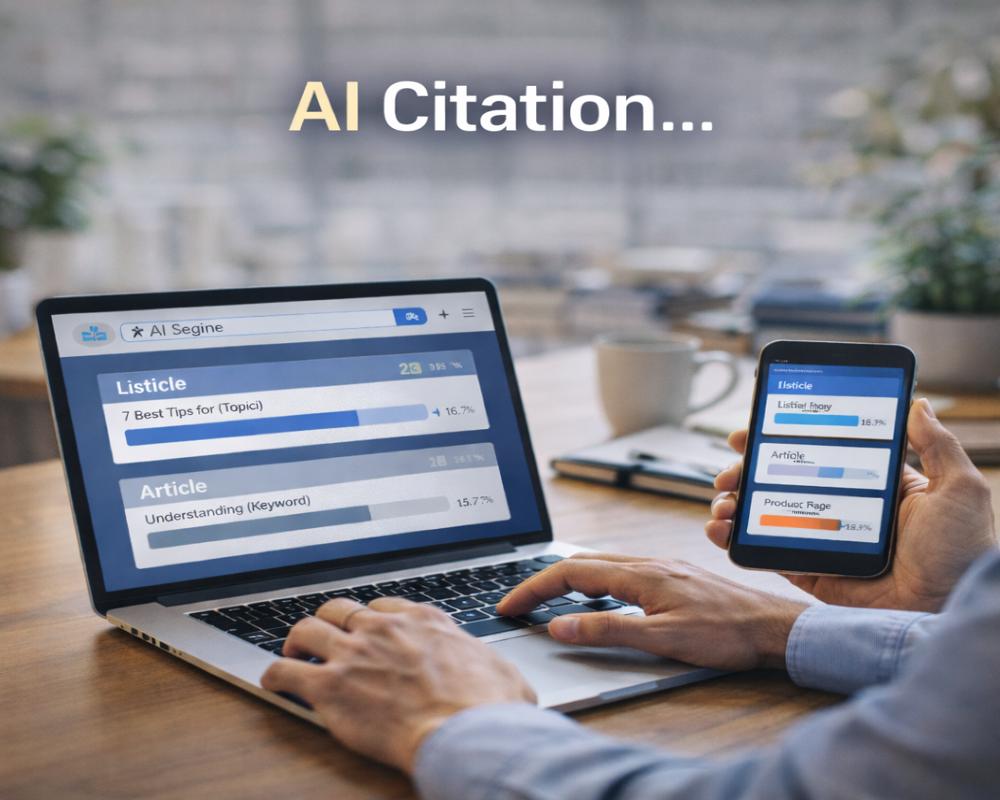

New research from Wix, analyzing 75,000 AI-generated answers across ChatGPT, Google AI Mode, and Perplexity, has produced the most specific content-format data available for AI search optimization: over half of all AI citations point to just three content formats. Listicles account for 21.9% of citations. Articles account for 16.7%. Product pages account for 13.7%. For content strategists who have been operating on intuition about which formats AI systems prefer, this data provides a concrete basis for restructuring content investment and for understanding why your current format mix may be generating fewer AI citations than your content quality warrants.
Breaking Down the Citation Data
The Wix study’s 75,000-answer dataset is large enough to identify meaningful patterns rather than noise. The three dominant formats together account for 52.3% of all AI citations, meaning that more than half of every AI-generated answer links back to one of these three page types. Everything else divides the remaining 47.7%.
But the headline numbers obscure an important nuance that the same research uncovered: AI systems cite different content formats for different query intents. This is the data point that makes the format findings strategically actionable rather than just descriptive.
Informational queries: 45.48% of informational query citations go to articles. When a user asks ChatGPT, Perplexity, or Google AI Mode to explain, define, or understand something, articles are the dominant cited format by a significant margin. Listicles and product pages fall behind articles sharply for pure informational queries.
Commercial queries: 40.86% of commercial query citations go to listicles. When a user is comparing options, evaluating alternatives, or asking which product, tool, or service is best for a specific use case, listicles dominate. The format’s structure,” named options, comparative attributes, clear differentiation,” is precisely what AI systems need to synthesize a useful commercial recommendation.
This intent-format correlation is the most important finding in the data. It means that optimizing solely for one format, regardless of query intent, leaves citation opportunities on the table. A brand that publishes exclusively long-form articles is well-positioned for informational query citations but underrepresented in commercial query citations. A brand that publishes exclusively listicle-format content is capturing commercial queries but missing informational query citations where articles dominate.
What Makes a Listicle Citable in AI Search
The 21.9% citation rate for listicles does not validate all listicle formats equally. The listicles earning AI citations share specific structural properties that distinguish them from the generic “top 10” content produced at scale for years.
AI-citable listicles have precise, specific list items, not vague category descriptions. “The 7 most effective schema markup types for e-commerce product pages” is more citable than “7 SEO tips for online stores. The specificity of each item determines whether the list provides sufficient information density for AI systems to extract useful answers.
They also include substantive descriptions for each item rather than one-line explanations. Each list item in a citation-worthy listicle functions as a mini-article in itself: what it is, why it matters, when to use it, and what outcome it produces. This depth is what allows AI systems to cite individual list items in context rather than needing to reference the entire piece.
Related research reinforces the citation concentration dynamic: the top 10 domains in any given topic take 46% of all ChatGPT citations in that topic area. The top 30 domains take 67%. This means that citation share is highly concentrated among a small number of authoritative sources per topic,” and that listicles from established, authoritative domains in a topic area earn disproportionate citations compared to equivalent content from less-established sources.
What Makes an Article Citable for Informational Queries
The 16.7% article citation rate and the 45.48% dominance for informational queries specifically reflect what makes an article function as a primary source for AI systems rather than a background reference.
The Growth Memo research on citation concentration by position in the document is directly relevant here: 44.2% of all LLM citations come from the first 30% of text. Articles that front-load their most citable content, specific data points, direct answers, and expert insights in the opening section will be cited more frequently than articles that build toward their conclusion. An article that answers the question in the first 150 words and then provides depth is more citation-worthy than one that provides depth and then answers the question.
Additionally, articles earn informational query citations when they provide information that cannot be synthesized from the existing top results. Original research, proprietary data, expert perspectives based on first-hand experience, and specific case examples with real metrics all constitute information gain. Generic articles that organize existing publicly available information do not generate new information and earn fewer citations as AI systems become more selective.
Product Pages: The Underrated 13.7%
The 13.7% product page citation rate is the most surprising finding for many content strategists, who typically do not optimize product pages for AI search visibility. It signals that AI systems are increasingly comfortable citing specific product or service pages directly when a query has transactional intent and a product page provides the most precise, complete answer.
Product pages earn AI citations when they contain more than specifications and pricing. The product pages being cited in the Wix data are those that answer the questions a buyer would ask during evaluation: what specific problems does this solve, for which users, with what measurable outcomes, compared to what alternatives. Product pages that function as comprehensive evaluation resources, not just purchase pages, earn citations in AI-generated answers to commercial queries where product pages are more useful than listicles or general articles.
Five Content Format Actions to Take This Week
1. Map Your Current Content Library Against Intent and Format
Categorize your existing content by both format (listicle, article, product page, other) and by primary query intent (informational, commercial, transactional). Identify gaps: if you have strong article coverage of informational topics but weak listicle coverage of commercial comparison queries in your category, you are underrepresented in the citation format that dominates those query types.
2. Build a Comparison Listicle for Every Core Commercial Category
For every commercial query category where your product or service is relevant, create a comprehensive, specific listicle for “best [category] tools,” “top alternatives to [competitor],” and “[use case] solutions compared” that provides genuine evaluation depth for each item. These are the highest-citation-probability pieces for commercial queries and are consistently underproduced by brands that focus primarily on educational articles.
3. Restructure Your Top Articles for Front-Loaded Citation
Review your highest-traffic article pages. For each, verify that the most citable content,” your primary data point, your direct answer to the main query, appears in the first 30% of the text. If your article spends its opening 300 words on context before reaching the insight, restructure it. This single change across your top 20 articles can measurably improve AI citation rates without changing the substance of the content.
4. Expand Your Product Pages Into Evaluation Resources
Audit your product and service pages against the questions a buyer would ask during the evaluation process. Add sections that directly answer: who this is for, what specific problems it solves, how it compares to alternatives, what measurable outcomes buyers have achieved, and what the limitations are. Product pages with this level of evaluative depth earn AI citations for commercial queries; product pages that only describe features and price points do not.
5. Track Citation Performance by Format in Your AI Monitoring
If you are using AI search monitoring tools, Profound, SE Ranking’s AI tracking, or manual ChatGPT/Perplexity testing, filter your citation data by content format. Which of your formats is generating citations? Which query intent categories are you appearing in, and which are you absent from? This data provides a format-level optimization roadmap grounded in your specific topic area rather than industry averages.
The Format Strategy Conclusion
The Wix citation data is one of the clearest format-level signals available for AI search optimization. Listicles for commercial queries. Articles for informational queries. Product pages for transactional queries. The brands that align their content format mix with the citation patterns of the AI systems their audiences use will build AI visibility systematically, rather than hoping that quality content in any format will be discovered and cited equally. It will not. Format matters as much as quality in determining which content AI systems reach for first.
Get the content format and AI search strategy intelligence that drives measurable results at ejournalz.com.