Google’s AI Overviews Are Wrong 1 in 10 Times — And Marketers Are Paying the Price

A 10% error rate doesn’t sound catastrophic until you realise Google’s AI Overviews now appear on billions of searches every month. That means hundreds of millions of users are potentially receiving incorrect information — and if your brand is cited in one of those wrong answers, the reputational and traffic implications are severe. For Indian digital marketers who have spent years building search visibility, this accuracy crisis represents both a warning and a strategic opportunity.
What the 10% Error Rate Actually Means
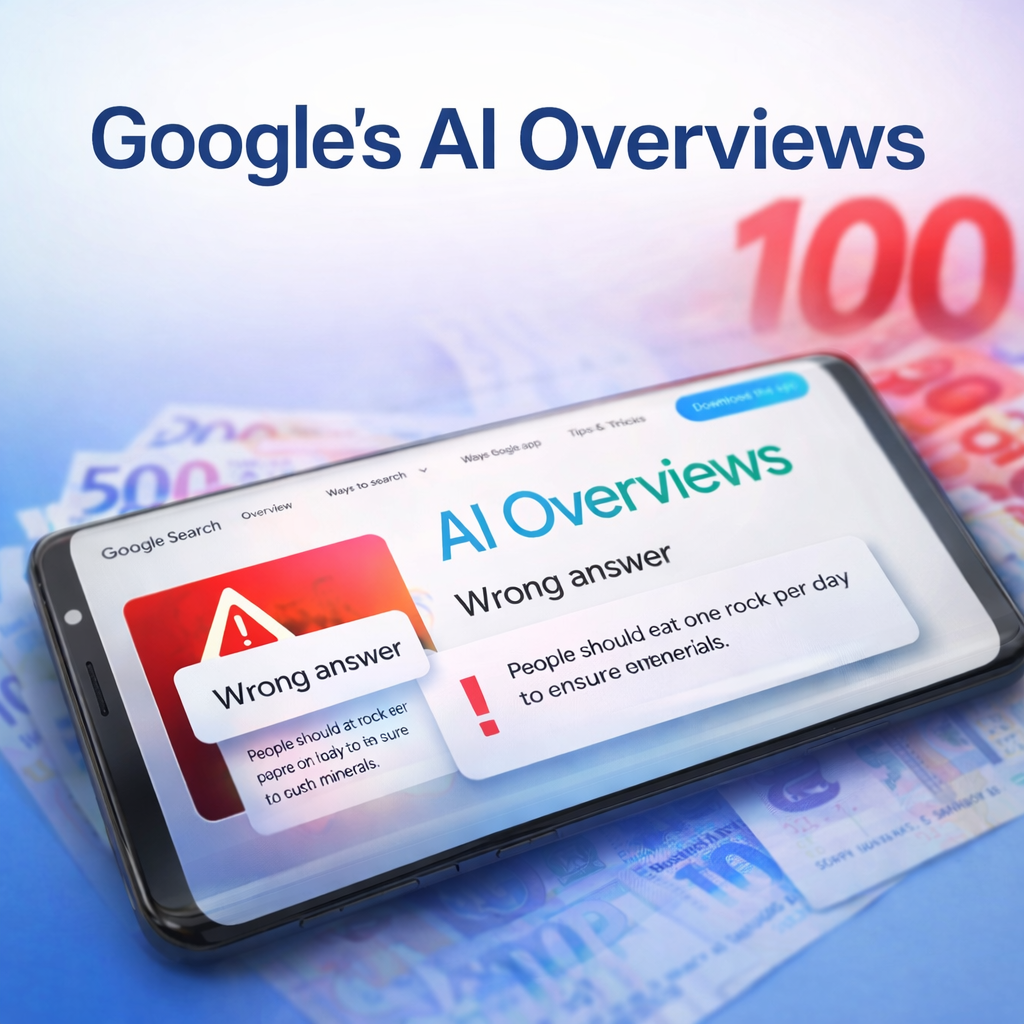
Recent analysis of Google AI Overviews across thousands of queries has revealed an error rate hovering around 10% — meaning one in every ten AI-generated summaries contains factually incorrect, outdated, or misleading information. The errors range from subtle misattributions to outright fabrications, often presented with the same confident tone as accurate responses.
For context, Google processes over 8.5 billion searches per day. AI Overviews now appear on a significant portion of those queries. Even a conservative estimate puts the daily volume of potentially inaccurate AI-generated answers in the hundreds of millions. This is not a fringe problem — it is a systemic one baked into the architecture of large language models that prioritise fluency over factual precision.
The error patterns are not random. Research shows AI Overviews are most likely to make mistakes in these categories:
- Time-sensitive information — prices, statistics, personnel, and policy details that change frequently
- Niche or regional topics — areas with limited high-quality training data, which disproportionately affects India-specific queries
- Multi-step reasoning queries — questions requiring synthesis across multiple sources
- Medical, legal, and financial advice — high-stakes domains where errors carry real consequences
Why This Crisis Is Different From Past Google Algorithm Problems
Indian SEO professionals have navigated countless Google algorithm updates — Panda, Penguin, Helpful Content, the March 2024 core update. Each created winners and losers, but the underlying mechanic was consistent: Google was trying to surface the best human-created content. The AI Overviews accuracy crisis is structurally different.
With traditional search, a user who clicks your result and finds accurate, useful information builds trust in your brand. With AI Overviews, Google synthesises an answer before the user ever reaches your site. If that synthesis is wrong and attributes the error to your content — or worse, if it correctly summarises your competitor’s outdated page as current fact — you have no direct mechanism to correct it.
This is the hallucination problem at scale. Unlike a single chatbot interaction that affects one user, a flawed AI Overview appears identically to every user searching that query until Google detects and corrects it — a process that can take days or weeks.
The India-Specific Dimension
India’s digital marketing landscape faces an amplified version of this problem. Several factors combine to increase AI Overview error rates for India-focused queries:
Data asymmetry: English-language content about Indian markets, regulations, and consumer behaviour is underrepresented in training data relative to US and UK content. AI models fill these gaps with approximations — often defaulting to global generalisations that are incorrect in the Indian context.
Regulatory complexity: India’s GST structure, digital advertising regulations, RBI guidelines, and state-specific rules change frequently. AI Overviews trained on data from even six months ago may confidently state outdated regulatory information.
Regional language queries: As voice search adoption grows — over 50% of Indian users now use voice search — AI Overviews for transliterated or regionally inflected queries show higher error rates than pure English queries.
What Marketers Must Do Right Now
1. Audit Your Brand’s AI Overview Presence
Search your brand name, key products, and primary service queries across Google. Screenshot every AI Overview that mentions your brand or cites your competitors. Flag any factual errors immediately using Google’s feedback mechanism. More importantly, document patterns — if AI Overviews consistently misrepresent your category, that is a content gap you need to address.
2. Build Correction-Ready Content
Create dedicated FAQ and fact-sheet pages that state your accurate information in clear, unambiguous language. Structure these pages so every factual claim is a standalone, crawlable sentence. AI systems extract information at the sentence level — vague or qualifying language increases misinterpretation risk. Think of these pages as your ground truth documents that you want Google’s AI to reference.
3. Implement Structured Data Aggressively
Schema markup — particularly FAQPage, HowTo, and Organisation schemas — provides machine-readable signals about what your content actually says. While schema alone cannot prevent AI hallucinations, it significantly increases the probability that your accurate information is correctly attributed. For Indian businesses, LocalBusiness and IndianOrganisation schema with verified NAP data adds another layer of factual grounding.
4. Monitor AI Overview Citations Weekly
Set up a monitoring workflow using tools like SE Ranking, BrightEdge, or even manual weekly checks for your highest-value queries. When you spot an error that affects your brand, submit feedback immediately and publish a corrective piece of content that directly addresses the inaccuracy. Speed matters — the longer a wrong AI Overview persists, the more users it misleads.
5. Diversify Beyond Google
The AI Overviews accuracy crisis is an argument for building visibility on Perplexity, ChatGPT search, and other AI-native platforms where citation practices differ and errors are more easily reported and corrected. Indian brands that establish authority on these platforms now will be better positioned as the search landscape continues to fragment.
The Opportunity Hidden in the Crisis
Every AI Overview error is a trust deficit that Google needs to close. Google’s response will inevitably involve prioritising sources with demonstrably high accuracy — brands that consistently publish well-sourced, structured, regularly updated content. The E-E-A-T framework is not just an SEO signal; it is increasingly the mechanism by which Google identifies which sources its AI should trust.
Indian marketers who invest in authoritative, accurate, well-structured content right now are building the exact asset class that AI-era search rewards. The accuracy crisis will force Google to be more selective about which sources it cites. Make sure your brand is on the right side of that selection process.
The brands that treat this moment as a content quality inflection point — not just an algorithm problem to game — will emerge from the AI Overviews era with stronger search presence than they had before it began.
Stay ahead of every Google AI development that affects your digital strategy. Explore more expert analysis at ejournalz.com — India’s destination for data-driven digital marketing insight.