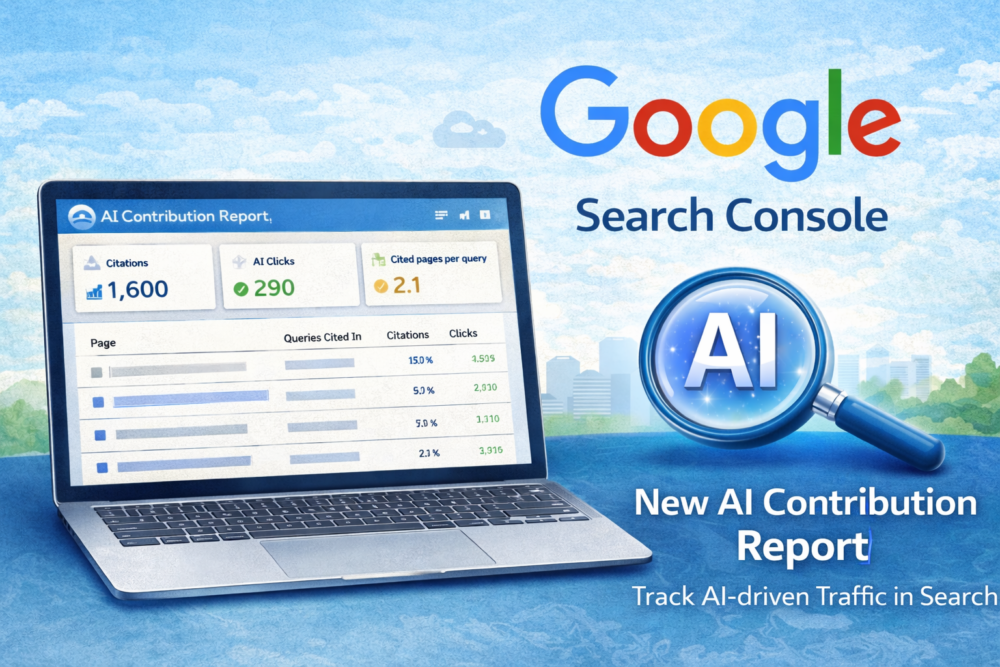

Google is piloting a new report inside Search Console called the AI Contribution Report. First spotted in Google’s support documentation on April 13, 2026, by Search Engine Roundtable, the feature appears under the “AI contribution pilot” reference, with no screenshots, no formal launch announcement, and no confirmed rollout timeline for general access. What it signals, however, is unambiguous: Google recognises that AI-driven search visibility has become a distinct and measurable channel, and that publishers need separate reporting to understand it. This is one of the most significant developments in search analytics since the introduction of position tracking, and the fact that it is still in pilot makes now the right time to understand what it will measure and how to position for it.
Why This Report Is Being Built Now
The timing reflects a specific gap in current Search Console reporting. Google has confirmed that AI Overviews and AI Mode clicks are included in the standard Performance report under the “Web” search type, but they cannot be filtered or viewed separately. Publishers currently have no native way to see how much of their traffic comes from AI-generated responses versus traditional organic results. They cannot see which pages are being cited in AI answers, how often those citations generate clicks, or which queries are triggering AI features that include their content.
This is not a minor reporting limitation. It means that publishers experiencing declining click-through rates cannot determine whether the drop is caused by AI Overviews absorbing clicks on their cited content, by ranking changes in traditional results, or by some combination of both. Strategic decisions about AI search optimization are being made without the data to back them up.
Microsoft moved first. Bing Webmaster Tools launched an AI Performance report in public preview on February 10, 2026. That report shows total citations, average cited pages per query, grounding queries, page-level citation activity, and trend data. Google’s AI Contribution pilot follows the same logic, and its existence confirms that this category of reporting is becoming an expected part of the webmaster toolset, not an optional extra.
What the Report Is Expected to Track
Based on the Bing implementation and the language in Google’s support documentation, the AI Contribution Report is expected to track several distinct metrics that are currently invisible in standard Search Console data:
Citation frequency. How often do AI systems, AI Overviews, AI Mode, and potentially Gemini reference a specific page when generating responses to queries? This is the foundational metric for understanding AI search visibility, analogous to impressions in traditional search reporting.
Grounding queries. The specific queries that triggered AI responses in which your content was cited. This data allows publishers to understand which topics and query types their content is being used to answer in AI-generated responses and to identify gaps where they should be cited but are not.
Page-level citation performance. Which specific pages on a site are being cited, at what frequency, and for which query categories? This page-level granularity is what turns the report from an interesting vanity metric into an actionable optimisation tool.
Citation-to-click conversion. The rate at which citations in AI responses generate actual site visits. Given that AI Overviews reduce click-through rates by 58% according to Ahrefs research, understanding the citation-to-click rate at a page level will be critical for assessing the real traffic value of AI search visibility.
Why This Changes How SEO Is Measured
The introduction of an AI Contribution Report forces a reconfiguration of how search performance is evaluated. The current standard metrics, impressions, clicks, average position, and CTR were designed for a search environment where ranking a page in traditional results was the primary lever for visibility. In an environment where 25% or more of queries trigger AI features that answer questions without clicks, those metrics increasingly misrepresent actual visibility.
A page that earns 10,000 traditional impressions and 800 clicks looks worse under current metrics than a page with 10,000 impressions and 1,000 clicks. But if the first page is cited in AI Overviews for 3,000 queries per month, reaching users who receive its information without clicking, its actual reach is significantly higher than the click metric suggests. Without AI contribution data, this distinction is invisible.
The AI Contribution Report introduces a new set of questions: Is my content being used to answer AI queries in my category, even when it does not generate traditional clicks? Which of my pages are functioning as AI information sources rather than traffic sources? Where am I cited by AI systems but not getting traditional ranking visibility, and vice versa? These questions will define how search performance is evaluated over the next two years.
Five Actions to Take Before the Report Launches
1. Check Your AI Visibility
Use available tools, like Profound or SE Rankings AI features, to see how your content appears in AI results. You can also manually check on ChatGPT, Perplexity and Google AI Mode. Take your 20 most important searches and note which platforms mention your content, which pages are mentioned and in what context. This will help you understand how well your content is doing now and how it improves later.
2. Make Sure Your Important Pages Are Ready
Google says that pages must be indexed and can show a snippet in search results to appear in AI features. Look at your important pages, like product pages and key content, and check if they have issues:
noindex tags, blocked robots.txt rules, canonicalisation problems, and content loaded with JavaScript that doesn’t show in the initial HTML
Fix any problems so these pages can show snippets before the AI report comes out.
3. Structure Content for AI Extraction
The content characteristics that earn AI citations are already known: direct answers in the opening section, FAQPage and HowTo schema, clear heading hierarchy, and specific factual claims as standalone sentences. Retrofit these structural elements to your highest-value pages now. When the AI Contribution Report launches, you want to see citation data for pages that have already been optimised, not pages that still need work.
4. Audit Your Schema Markup Coverage
Schema markup is the clearest machine-readable signal you can provide to AI systems about what your content answers. Run a schema audit across your top 50 pages. Identify pages missing FAQPage, HowTo, Article, Product, or Organisation schema that would benefit from it. Implementing schema before the AI Contribution Report launches means your optimised pages will have had time to be indexed and cited before you start measuring performance.
5. Brief Your Stakeholders on the New Measurement Framework
When the AI Contribution Report becomes generally available, search performance reporting will need to change not only in the metrics tracked, but also in how performance is communicated to stakeholders. Clicks and CTR from AI-cited pages will be lower than from equivalent traditionally-ranked pages, by design. Impressions in AI responses have a different commercial value than traditional impressions. Begin briefing marketing leadership, clients, and reporting stakeholders now on the fact that AI search visibility is a distinct channel with distinct metrics, so that when the report data arrives, the conversation is about optimisation, not confusion about why click metrics look different from expectations.
The Measurement Gap That Is About to Close
The Google Search Console AI Contribution Report pilot is the clearest signal yet that AI search visibility has matured from an emerging concern into a measurable, trackable channel that Google considers part of its core publisher toolset. The gap between what publishers can currently measure and what is actually happening to their content in AI search responses is significant. When that gap closes, whether through this pilot becoming general access or through continued improvement of third-party tools, the publishers who have been building for AI visibility rather than waiting for measurement tools will have the data advantage. Prepare now so that when the data arrives, it confirms progress rather than reveals a standing start.
Stay ahead of every Google Search development that matters at ejournalz.com.