44% of All LLM Citations Come From the First 30% of Your Content — The Research That Should Change How You Structure Every Page

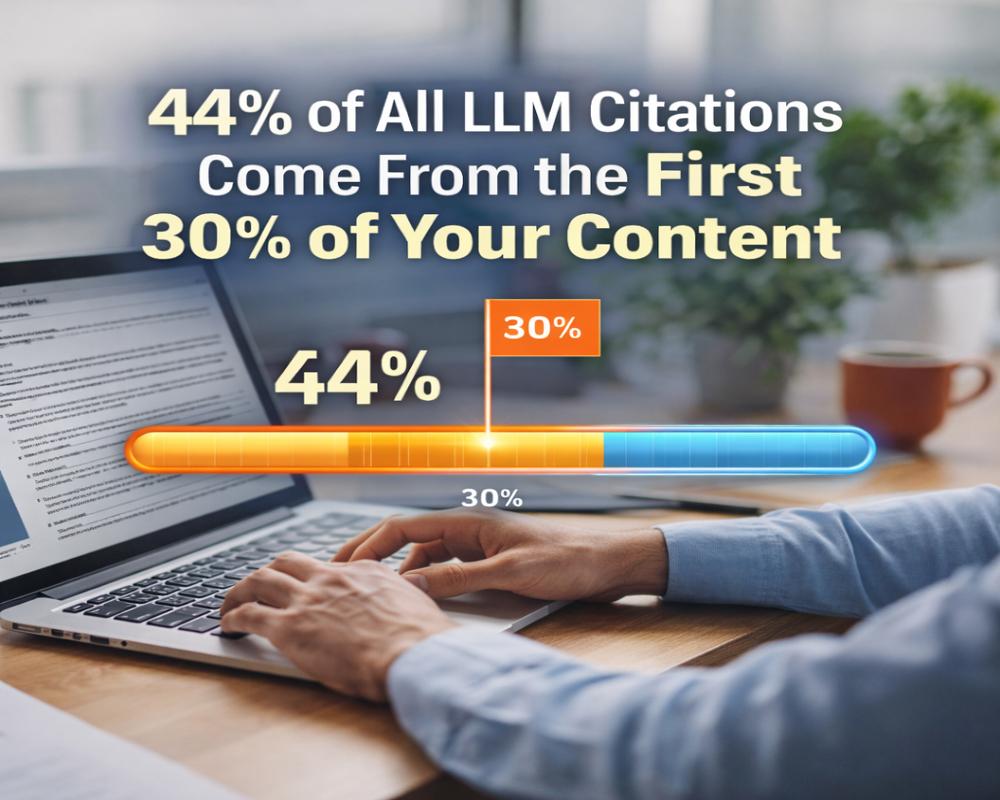
Research from Growth Memo analyzing thousands of AI-generated answers has produced one of the most actionable content findings of 2026: 44.2% of all LLM citations come from the first 30% of a page’s text. The middle section — from 30% to 70% of the article — contributes 31.1% of citations. The final third produces just 24.7%. The implication is direct: if your most important data, insights, and expertise are buried beyond the first few paragraphs, AI systems are largely overlooking them. Your content quality is not the problem. Your content structure is.
Why LLM Citation Concentrates at the Top
Understanding why citation probability is front-loaded requires understanding how large language models process web content. When an AI system retrieves a page to answer a query, it does not read the full document with equal attention. It applies a weighted extraction process that prioritizes early content, both because well-structured documents place their primary conclusions first and because processing efficiency favours extraction from the beginning of documents.
AI systems have learned this structural pattern from training on billions of documents and calibrate their extraction accordingly. An article that follows the journalistic inverted pyramid — most important information first, supporting detail later — will consistently be cited more frequently than one that builds toward its conclusion. There is also a confidence signal at play: opening sections that state clear, direct, standalone factual claims provide high-confidence extraction targets. Introductory sections that contextualize and warm up to the main point are lower-confidence targets and get proportionally fewer citations.
A related data point reinforces this: just 10% of ChatGPT’s short-tail query results overlap with Google’s SERPs. AI systems are making independent citation choices based on content-structure signals — and the early placement of high-value content is among the most influential of those signals.
The Structural Mismatch Most Content Teams Have
Most content teams have been trained on structures that prioritize engagement, keyword placement, and editorial flow. The standard long-form template used across the industry typically looks like this:
- Contextual introduction explaining why the topic matters (200–300 words)
- Background and problem framing (150–200 words)
- Main content body with subheadings containing the actual insights (800–1,000 words)
- Conclusion summarising key points (150–200 words)
Under this structure, the most citation-worthy content — the insights, data points, and expert recommendations — appears predominantly in the middle section, which contributes only 31.1% of LLM citations. The introduction, typically the least informative section, occupies the high-citation opening third.
This is not a minor optimization gap. It is a structural mismatch between how content is typically created and how AI systems consume it — one that suppresses citation rates across content libraries that contain genuinely valuable, citable information AI systems never reach.
The AI-Optimized Content Architecture
Restructuring for AI citation does not mean abandoning readability or editorial quality. It means strategically repositioning elements within the same content.
The Opening Third — Your Highest-Citation Real Estate
This section must contain your most citation-worthy content: your primary data point or statistic, your direct answer to the query the content addresses, your core insight or recommendation, and clear source attribution when referencing external research. Every sentence in this section should be a potential standalone citation — complete, factually precise, and self-contained enough to be extracted without the surrounding context.
Remove from this section: vague contextual setup, rhetorical questions, extensive historical background that does not contain your primary insight, and filler phrases like “In today’s rapidly evolving landscape…” These consume your highest-citation-probability real estate without contributing anything extractable.
The Middle Section — Supporting Evidence and Depth
Use this section for detailed explanation, supporting evidence, case studies, and nuanced analysis. It still accounts for 31.1% of citations — meaningful, not negligible — but it operates differently from the opening. Structure it with H2 and H3 subheadings that each contain a citation-worthy summary. A subheading that states a quantified claim is more citation-worthy than one that announces a topic. The heading text itself is an extraction candidate, separate from the content beneath it.
The Final Third – Reinforcement and Action.
The concluding section adds 24.7% of citations – still noteworthy, especially to those who have read the entire work. Use it with your best future-oriented thinking, most practical suggestions and contents that will be better placed since they will come after the reader has had the entire context. Summarising your main data points in a conclusion section will provide a second extraction point for AI systems that emphasize conclusion sections.
Five Structural Changes to make this Week.
First Rule: Add your best data point first.
Write the first paragraph of your five most significant pieces of content one time only: Does the first sentence include a citable claim? The article titled “Brands that restructure content to be cited by AI” passes the test, claiming that up to 40 per cent of generative search responses increase after restructuring the content. Does not work in a competitive digital world where content marketing has never been more important. A citable claim must be found in the first sentence of each piece.
2. Change Topic Labels into Factual Claims.
AI systems extract text, place it in a subheading, and cite it regardless of the text below. Make each H2 a heading that can be confidently used as a fact. The title of the article has been changed to “Understanding Performance Max” to “Performance Max Now Generates AI-Based Assets 23% Higher ROAS.” Content Strategy Basics are changed to “Brands Publishing Original Research Are Cited 3x More Frequently by ChatGPT than Brands Aggregating Existing Content.” This alone, as a change to an existing content library, would significantly raise citation rates without requiring body copy to be rewritten.
3. Include a Key Facts Block at the Top of Each Long Article.
In articles longer than 1,000 words, include a structured section, like Key Statistics or Quick Facts, right after your opening paragraph. Name four or six of your best data points, which can be used in a reference list in brief bullet points. This establishes a high-density extraction area at the start of the document – the most likely area of citation – and several standalone facts which AI systems can use to cite separately to different query contexts.
4. Move Your Best Examples Into the First Third
Specific examples with quantified outcomes are among the most frequently cited content elements. The instinct to save your strongest case study for the middle or end of an article — to build up to it narratively — costs citation probability. Move your most specific, best-quantified examples into the first 30% of the content. The narrative payoff matters less than the data’s citation value.
5. Audit Your Top Content for Front-Loading Gaps
Identify your 20 highest-traffic or most commercially important pages. For each, read only the first 30% and ask: if an AI system processed only this section, would it have sufficient grounds to cite this page as an authoritative source on this topic? If the opening is primarily context-setting rather than insight-delivering, you have a high-priority restructuring opportunity. This audit typically reveals that most citation value is concentrated in a small number of well-structured pieces, while the majority of the library is under-optimized.
The Compounding Effect
Restructuring for AI citation creates compounding advantages across multiple channels simultaneously. Content that leads with high-value insights also performs better in social sharing — the opening paragraph is what appears in link previews on LinkedIn and Slack. It performs better in email — the opening determines whether recipients continue reading. It performs better on traditional search results pages where the direct answer appears early and better matches the featured snippet criteria.
The 44.2% citation concentration in the opening third is not an arbitrary AI system quirk. It reflects how all readers — human and machine — process information under time and cognitive constraints. Content that puts its most valuable insights first serves every channel and every reader more effectively. The expertise is already in your content library. Moving it to where AI systems are most likely to find it is the work that unlocks the value.
Get an evidence-based content marketing strategy that works in the AI-era search at ejournalz.com.